

Registered for high-intensity care
We're registered with the NDIS Commission for high-intensity daily personal activities. See our entry on the register. Tell us what's needed and we'll match a worker trained in that skill.
What counts as complex care?
The NDIS calls it high-intensity daily personal activities, and lists eight of them. Each needs a written plan and a worker trained in that person's needs.
- Complex bowel care: routines that need specific training.
- Tube feeding, such as a PEG (enteral feeding).
- Urinary catheter care: indwelling, suprapubic or in-out catheters.
- Severe swallowing difficulty (dysphagia) and safe mealtimes.
- Complex wound care, including serious pressure injuries.
- Injections under the skin, given as prescribed.
- Tracheostomy care and ventilator support.
Epilepsy and seizure support isn't one of the eight, but it has its own worker skills guide. Treat it with the same care.
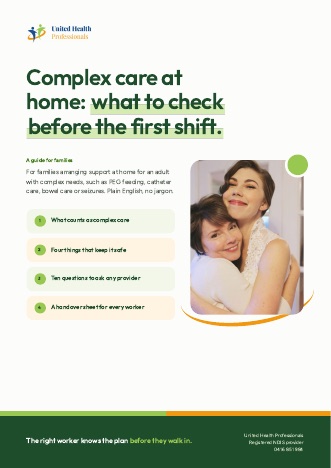
Free guide · PDF, 6 pages
Complex care at home
What counts as complex care, four things that keep it safe, and a handover sheet for every worker.
Thanks, your guide is ready.
Download the PDFWe'll give you a quick call in the next day or so to see if it helped. No pressure.
Four things that keep complex care safe
- A written plan for each needWritten with the person, updated when anything changes, with their health reviewed regularly by a qualified health practitioner.
- Workers trained for this personNot just a certificate. Someone checks the worker can follow this plan before they work alone.
- A backup who's trained tooSick days happen. The replacement should know the plan before they walk in.
- Notes, and a plan for problemsWhat's written down after each shift, what the worker does if something changes, and who they call.
In an emergency, always call 000 first. Then follow the person's plan and call the people it lists.
Describing complex needs at your plan meeting
The NDIS needs to understand how often each need happens, how long it takes, how many people it takes, what happens overnight and what happens when something goes wrong. Reports from the person's health practitioners help, like their GP, specialist, continence nurse or speech pathologist.
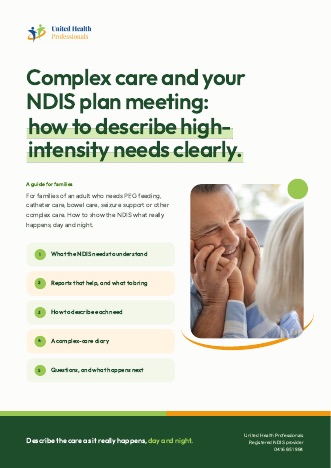
Free guide · PDF, 7 pages
Complex care and your plan meeting
How to describe high-intensity needs clearly, with a care diary and a worksheet for each need.
Thanks, your guide is ready.
Download the PDFWe'll give you a quick call in the next day or so to see if it helped. No pressure.